Posted on November 9th, 2018
Deer control isn’t something most homeowners think about until they notice the damage. As fall transitions to winter across Massachusetts and New Hampshire, deer activity increases dramatically, and your carefully maintained landscape becomes an all-you-can-eat buffet. If you’ve invested time and money into professional lawn care and healthy shrubs, the last thing you want is to watch hungry deer destroy months of progress in a matter of weeks.
The reality is sobering: a single adult deer can consume up to 6 pounds of plant material every single day. Multiply that by a small herd visiting your property throughout the winter, and you’re looking at hundreds of pounds of damage to your trees, shrubs, and ornamental plantings. In New England, where winters are long and natural food sources become scarce under snow cover, residential landscapes become prime feeding grounds for deer populations.
Understanding why deer activity spikes in late fall and winter, and knowing how to protect your property, can save you significant money and frustration come spring.
Don’t wait until you see damage. The team at Turf Unlimited offers professional-grade deer protection solutions that work all winter long. Call us today at (888) 649-9919 to protect your landscape investment.

Here’s what every Massachusetts and New Hampshire homeowner should know about winter deer control:
Three major factors drive increased deer activity on residential properties throughout the late fall and winter months in New England.
Mating season runs from October through December, with peak activity in November. During the rut, bucks chase does aggressively, dramatically expanding their range and reducing their normal caution around human activity. You’ll see deer in your yard at all hours, often in groups, and they’re far less skittish than usual.
Hunting season pushes deer into residential areas where they feel safer. Massachusetts and New Hampshire both have active hunting seasons from fall through winter, and deer quickly learn that suburban neighborhoods offer refuge from hunting pressure. Once they discover your property is a safe haven with available food, they’ll return repeatedly and bring others.
Winter food scarcity is the biggest driver of landscape damage. As snow covers natural browse and temperatures drop, deer become desperate for calories. Your evergreen shrubs, young tree bark, ornamental plantings, and even dormant perennials become critical food sources. Arborvitae, yews, rhododendrons, and hostas are particular favorites and can be stripped to bare stems overnight.
In Massachusetts and New Hampshire, our long winters (often lasting through March) mean extended feeding pressure on residential landscapes. Unlike milder climates where natural forage remains available year-round, New England properties face months of potential deer damage.
Understanding what deer damage looks like helps you spot problems early and take action before significant harm occurs.
| Type of Damage | What It Looks Like | Timing | Risk Level |
|---|---|---|---|
| Browse Feeding | Ragged, torn edges on leaves and twigs (deer have no upper incisors) | October–March | High |
| Bark Stripping | Vertical scrapes on young tree trunks, often 2–4 feet high | Late winter (food scarcity) | Very High |
| Buck Rubs | Shredded bark on small tree trunks from antler rubbing | September–November | High |
| Trampling | Flattened ground cover, damaged lawn edges near beds | Year-round | Moderate |
| Complete Defoliation | Shrubs stripped bare to woody stems | December–February | Very High |
Evergreens are particularly vulnerable because they don’t regenerate stripped foliage easily. A rhododendron or yew that’s been stripped bare may take years to recover, or may die entirely. Deciduous shrubs typically recover better, but severe bark damage can kill branches or entire trees.
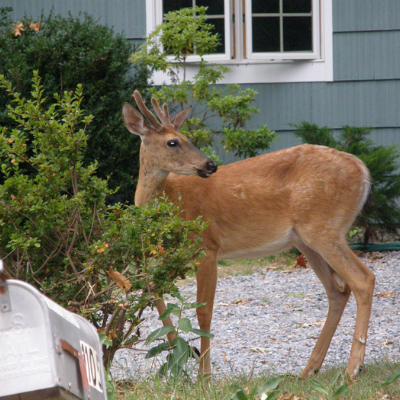 Deer rely heavily on their sense of smell to locate food and detect danger, making scent-based repellents a logical first line of defense.
Commercial repellents use odors that deer find offensive or that signal danger. Common formulations include rotten egg (sulfur compounds), dried blood, predator urine (coyote or fox), garlic, hot pepper, and putrescent solids. These products are applied directly to plants or around the perimeter of protected areas.
The benefits of repellents include:
However, repellents come with significant drawbacks for New England homeowners. Application frequency is the biggest challenge: you’ll need to reapply every 2–3 weeks under normal conditions, and immediately after any rain or snow. Given that Massachusetts and New Hampshire receive regular precipitation throughout fall and winter, you could be reapplying weekly during wet periods.
Habituation is another serious problem. Deer are intelligent and adaptable. After repeated exposure to the same smell, especially if they’re hungry enough, they’ll simply tolerate it and feed anyway. This means you need to rotate between different scent types, purchasing multiple products and maintaining a rotation schedule.
For homeowners maintaining comprehensive landscape investments alongside services like core aeration and overseeding, the time and effort required for effective DIY repellent programs often isn’t practical.
 While repellents target deer’s sense of smell, deterrents rely on sight, sound, and physical barriers to keep deer away from your property.
Effective deterrent methods include:
The deterrent challenge: Like repellents, deterrents lose effectiveness over time as deer become habituated. You’ll need to constantly move devices, change patterns, and introduce new elements to maintain fear responses. For working homeowners, especially during busy holiday seasons, maintaining an effective deterrent program is unrealistic.
The most effective approach to winter deer control in Massachusetts and New Hampshire combines the best aspects of repellents and deterrents while eliminating their maintenance burdens.
Professional-grade deer guard products use advanced formulations that remain effective for months, not weeks. At Turf Unlimited, we apply our deer protection treatment in late fall, just before winter weather sets in. This single application creates a protective barrier that lasts throughout the winter season, protecting your trees and shrubs through the entire period of peak deer pressure.
Advantages of professional deer guard services:
Think of professional deer guard as insurance for your landscape. You’ve already invested in quality lawn seeding, proper tree and shrub care, and perhaps sprinkler installation to keep everything healthy. Winter deer damage can undo months of that work in days.
Timing your deer control efforts correctly makes the difference between prevention and damage control.
Follow this seasonal schedule for best results:
The key principle: Prevention is far more effective and affordable than treatment. Once deer establish a feeding pattern on your property, they’ll remember it year after year and return with their offspring. Breaking that cycle requires consistent protection over multiple seasons.
1. Will deer eat plants treated with deer repellent if they’re hungry enough?
Yes. While repellents reduce feeding pressure under normal conditions, extremely hungry deer (especially late winter during deep snow cover) may tolerate unpleasant smells and taste to get needed calories. This is why professional-grade deer guard products use formulations that remain effective even under high deer pressure. Combining scent deterrents with taste-based repellents provides better protection than either alone.
2. Are there any truly deer-proof plants for New England landscapes?
No plant is completely deer-proof, but some are more resistant than others. Deer generally avoid plants with strong scents (lavender, Russian sage), fuzzy or spiny textures (barberry, lamb’s ear), or toxic properties (daffodils, foxglove). However, preferences vary by region and deer population, and hungry deer will eat resistant plants when food is scarce. The safest approach is protecting all valuable plantings rather than relying on deer-resistant species alone.
3. How much damage can deer actually do in one winter?
Significant. A single adult deer eats 6-8 pounds of plant material daily. A small group of 3-4 deer visiting your property regularly throughout a 4-month winter can consume 2,000+ pounds of foliage, bark, and twigs. This can completely defoliate expensive foundation plantings, kill young trees through bark stripping, and destroy years of landscape investment. We’ve seen properties lose $5,000-$10,000 worth of plantings in a single winter without protection.
4. Can I use homemade deer repellents like soap or human hair?
Homemade solutions have limited effectiveness. Bar soap (especially strong-scented types) and human hair suspended in mesh bags do repel deer to some degree, but they require frequent replacement and work only at very close range. For small garden beds, they might provide temporary relief. For protecting an entire landscape through a New England winter, homemade solutions aren’t reliable enough. They also look unsightly in foundation plantings and front yard areas.
5. Will deer come back if I had deer damage last winter?
Almost certainly, yes. Deer have excellent spatial memory and share information about food sources with their family groups. If your property provided food last winter, deer will return this winter and teach their fawns (now yearlings) to feed there too. Breaking this cycle requires consistent protection for 2-3 seasons to remove your property from their established feeding routes. This is why investing in professional deer protection now saves more money than addressing damage repeatedly each spring.
Winter deer damage is preventable, but it requires action before the damage begins. Once deer strip your rhododendrons bare or girdle your young ornamental trees, the harm is done and recovery takes years or may not be possible at all.
Massachusetts and New Hampshire homeowners invest heavily in their landscapes: professional lawn care, healthy trees and shrubs, proper watering systems, seasonal maintenance. Protecting that investment from winter deer damage is just as important as your grub control program or chinch bug treatment in summer.
At Turf Unlimited, we’ve helped thousands of homeowners across Massachusetts and New Hampshire protect their properties from winter deer damage. Our professional deer guard application provides season-long protection without the hassle, expense, and time commitment of DIY methods that rarely work as needed.
Don’t wait until you see damage. Contact Turf Unlimited today or call us at (888) 649-9919 to schedule your deer protection service. Let us help you keep your landscape beautiful and healthy all winter long.